Trump's North Korea overture triggers fears for US alliances
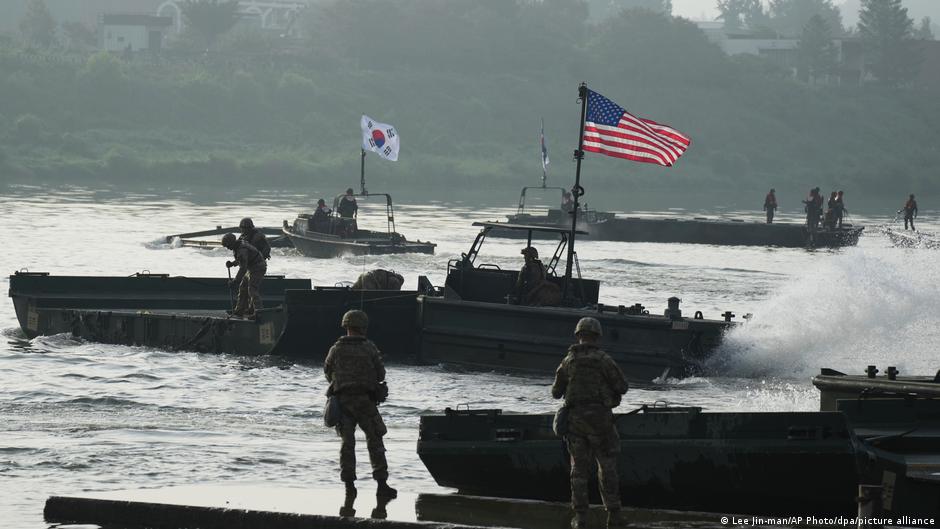
US President Donald Trump announced on Sunday that he had instructed the Pentagon to limit the scale of US involvement in military exercises with South Korean units planned for this week, causing alarm among South Koreans and experts concerned at the deteriorating security situation in Northeast Asia
In a social media post, Trump said he had ordered the US to "substantially reduce" its involvement, claiming the exercises were "expensive."
Trump added that US involvement in the exercises would send a "signal that is totally inappropriate and hostile" to North Korea, which he said has been "unthreatening and respectful" to his presidency.
Trump's statement seemed to disregard North Korea's recent spate of missile tests, and Pyongyang threatening last Friday a "new level" of nuclear deterrence in response to the planned drills, which North Korean state media called "a rehearsal for an invasion war."
The US president also hinted that his decision was in part influenced by the South Korean government's refusal to assist in the "denuclearization" of Iran.
On Monday, Trump doubled down on his decision to limit the scope and scale of the 11-day Ulchi Freedom Shield exercises, which started the same day, telling reporters in the White House that North Korean leader Kim Jong Un had responded to his overture for a resumption of talks.
Fraying US alliances in Asia
Paring back the annual exercise comes as Kim is emboldened by a deepening alliance with Russia. At the same time, Pyongyang in recent years has removed foundational guardrails of inter-Korean relations by officially abandoning the decades-long goal of reunification, while rewriting its constitution to designate South Korea as its principal enemy.
"The cost savings from downsizing drills are marginal, while the diplomatic benefits for relations with North Korea are doubtful," said Leif-Eric Easley, a professor of international studies at Ewha Womans University in Seoul.
Easley added that Kim has shown "no interest" in offers from Washington and Seoul to discuss considering scrapping North Korea's nuclear arsenal.
"Trump's recent social media posts about Kim Jong-un suggest a willingness to reengage, but North Korea is busy profiting from Russia's war against Ukraine while modernizing its own military," Easley told DW.
He added that scaling back combined defense exercises "can damage alliance coordination, slow the process of South Korea taking on greater responsibility for its own defense and weaken deterrence against possible conflicts in Asia."
South Korea walks a fine line
Concern in South Korea has been reflected in newspaper editorials on Tuesday, with the Chosun Ilbo highlighting the importance of joint drills in safeguarding the nation from an aggressive and unpredictable neighbor and warning that Trump is risking the foundations of the alliance.
David Silbey, a professor of military history and defense policy at Cornell University in the US, pointed out in a statement that the move comes as US military forces are overstretched, with the US Navy already redirecting forces from the Pacific to the Middle East amid the Iran war.
"Reducing the commitment to the South Korean exercises probably reflects a reduction that was inevitable anyway," he writes, adding that offering Kim talks also reflects "the continuing neglect of American allies," and that Taiwan, Japan and the Philippines are all watching.
Beijing is, of course, also monitoring developments closely, albeit from a position of an adversary rather than an ally, he said.
According to the Associated Press, Trump made the decision to pull back on exercises without consulting South Korea, and it was unclear exactly which parts of the exercises were being downsized.
On Monday, the office South Korean President Lee Jae Myung said the South would continue to "coordinate closely" with the US on "maintaining a firm combined defense posture and on their joint exercises and training."
During a regular Cabinet meeting on Tuesday, President Lee lauded the US-South Korea alliance during a and called for South Korea to bolster its own forces.
"When we build up our strengths, our value and importance as an ally will further grow," he said.
A 'victory' for Kim Jong Un?
In the US, politicians from both parties have pushed back against Trump's order on the grounds that it weakens the alliance with South Korea and benefits US adversaries.
Senator Jack Reed, the top Democrat on the Senate Armed Services Committee, described the move as, "another inane, haphazard decision by President Trump and his chaotic administration."
"Kim Jong Un has won a propaganda victory and South Korea, one of our strongest allies, has been punished for no reason beyond Trump's ego," he said in a statement.
Republican Senator Thom Tillis underlined South Korea's long military alliance with the US and argued that cutting the scale of the exercises could help Russia by enabling North Korea to send more troops to fight in Ukraine.
Kim Sang-woo, a former politician with the left-leaning South Korean Congress for New Politics and now a member of the board of the Kim Dae-jung Peace Foundation, said that the majority of ordinary South Koreans are "very concerned" about the deteriorating alliance and the implications of Trump favoring Pyongyang over Seoul.
"People are alarmed," he told DW. "Trump threatened to withdraw US forces during his first term unless South Korea paid more to keep them here, he has imposed huge tariffs on our exports to the US and now he is approaching the North in a manner that shows he wants to establish a new relationship and sign a peace treaty that ends the Korean War."
Little chance for change in Pyongyang
However, Kim added that Trump still has an ally in South Korean President Lee.
"I do not think the Lee government is at all worried or disappointed in this plan," he said. "Their policy has always been to try to reinstate friendly relations with the North, even though the North has shown no intention of reciprocating."
On Monday, Lee's office issued a statement expressing optimism for "meaningful dialogue" between Trump and Kim Jong Un, which could promote peace in the region.
However, South Korean commentator Kim said that there is no indication that Pyongyang will change its belligerent posture towards the US or South Korea.
"The last time Kim Jong Un held talks with Trump, in Vietnam in 2019, North Korea was in a position of weakness," he said.
"Today, Kim has forged a solid alliance with Russia that is bringing him military technology, energy supplies and economic assistance, while China is also reaching out to the North because it does not want to be completely out of the picture," he added.
"Right now, Kim is in a very comfortable position and you could argue that he no longer needs the US," he said. "But for most people in South Korea, it comes down to something much more basic; we just do not trust the North."
Edited by: Wesley Rahn
Reporting originally appeared via DW News. Read the full source for additional context.