No law requires President’s portrait to be displayed in offices: Laywer Paul Muite
This story has significance for readers across Kenya and beyond.
No law requires President’s portrait to be displayed in offices: Laywer Paul Muite
Audio By Vocalize
The practise, it has been legally argued, is rooted in executive custom rather than constitutional or statutory mandate.
Under Article 9 of the Constitution of Kenya (2010), the recognized national symbols are limited to the National Flag, the National Anthem, the Coat of Arms, and the Public Seal.
The presidential portrait is not designated as a national symbol, meaning there is no legal obligation under Kenyan law compelling citizens, business owners, or elected officials to display it in their private or constituency offices.
Prominent constitutional lawyers Paul Muite and Willis Otieno have weighed in on this issue, underscoring that the practice of displaying the president's picture is purely a matter of political tradition inherited from the colonial era and maintained across post-independence administrations.
According to their constitutional interpretation, no statute penalizes an individual or institution for choosing not to display the official portrait or removing it from a private space.
While state departments and executive branch offices maintain the display as a matter of administrative protocol, private entities and independent constitutional offices face no legal liability, fines, or criminal prosecution for omitting the image.
Paul Muite wrote: "There is, in fact, NO Law requiring the hanging of the President's portrait in offices & Public places. It is all part of Imperial Presidency hangovers. The illegal enforcement is via denial of Licenses absent a portrait in business premises."
Lawyer Willis Otieno had himself touched on the same topic over a year ago, stressing that the practise was rooted in colonial-era customs, mainly meant to reinforce 'loyalty to the ruling figure'.
"It’s a colonial-era habit, not a legal requirement. A relic of state symbolism meant to reinforce loyalty to the ruling figure, not the Constitution. Over time, it became custom reinforced by provincial commissioners and local administrators during KANU days but never codified in any statute," he tweeted on July 15, 2025.
"No article in the Constitution, no section in the Penal Code, Companies Act, Public Order Act, or any binding regulation makes it mandatory."
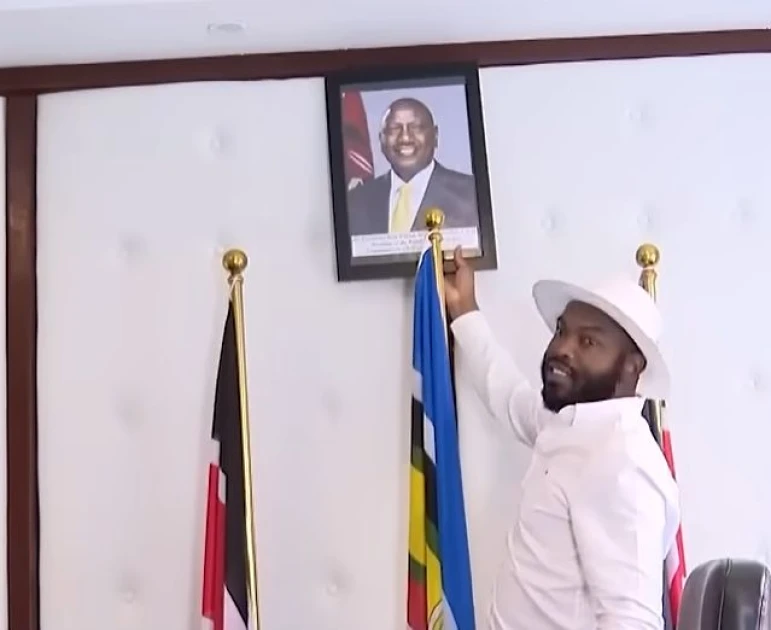
This legal distinction re-emerged following an incident involving Gatundu South MP Gabriel Kagombe.
After cutting ties with the ruling United Democratic Alliance (UDA) party, MP Kagombe publicly removed President William Ruto’s official portrait from his office, citing a political rift and declaring the end of his alignment with the administration.
The lawmaker went ahead to accuse the president of betraying the mountain and failing to fulfil his promises to his Gatundu South constituents and the Mount Kenya region at large.
“Monday’s meeting in Naivasha was the burial of UDA. We buried that party, and that is the truth. They can’t get the 5,000 votes they got in Ol Kalou. It is only a matter of time before Mount Kenya MPs ditch UDA and join the Wamunyinyi movement.”
The gesture highlighted how the display of the presidential portrait in political offices often operates as a symbolic declaration of loyalty or alignment rather than a binding legal requirement.
Government communications over successive administrations have consistently affirmed that while displaying the head of state’s portrait remains a widely practiced tradition, compliance outside state executive structures is strictly voluntary.
Reporting originally appeared via Citizen Digital. Read the full source for additional context.