Today's goons could become gangs terrorising Kenyans in the future
This story has significance for readers across Kenya and beyond.
Audio By Vocalize
There is a dangerous assumption in Kenyan politics that political goons are disposable.
Politicians imagine they can recruit angry young men, finance them, arm them with crude weapons, unleash them against opponents and send them home when elections end. History suggests otherwise.
The young men cultivated for political intimidation may not disappear after 2027. When campaign money dries up, rallies end and protection fades, some may reorganise into criminal gangs. Having learnt that violence pays, they may turn the same methods against communities and against the politicians who empowered them.
Political goonism is not merely an electoral problem. It may incubate Kenya’s next national security crisis.
Critics of President William Ruto see echoes of Daniel arap Moi’s era. They point to co-opted opponents, weakened institutions, loyal networks and patronage used to neutralise resistance.
Whether every comparison holds is debatable, but the similarities matter.
Moi understood political patronage. Opposition politicians could be persuaded, accommodated or isolated. Strategic appointments helped construct networks of loyalty. State resources and access became instruments for consolidating power.
Critics now fear Kenya is witnessing an adaptation of that playbook. The broad-based arrangement that brought sections of ODM closer to Kenya Kwanza has intensified those suspicions.
Appointments of Opposition-associated figures can be presented as inclusion. But when inclusion weakens scrutiny, citizens may ask whether they are witnessing reconciliation or elite co-option.
The deeper danger is the normalisation of organised political violence. Kenya should remember how politically useful groups acquire lives of their own. Mungiki’s history, although more complex than simply being Moi’s gang, warns about politics, alienated youth, criminal organisation and State power. Groups courted by political actors can eventually become impossible to control.
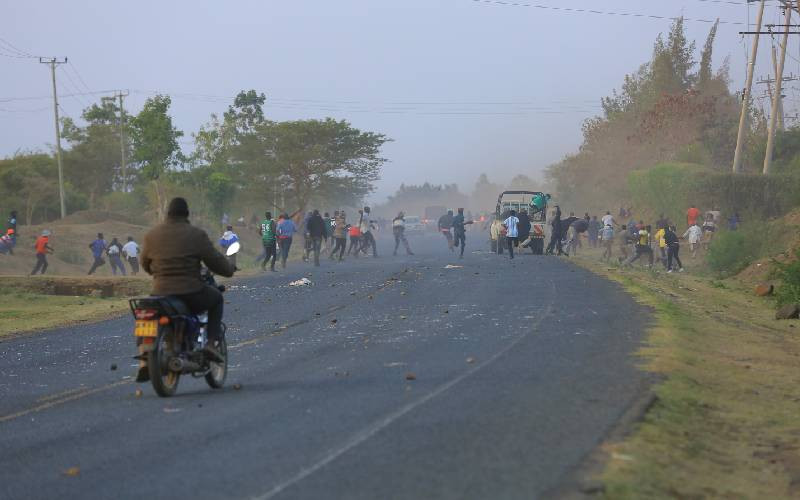
Today’s political goons could follow the same path. Imagine hundreds of young men accustomed to disrupting meetings, attacking convoys, intimidating journalists, blocking roads or assaulting opponents for pay.
What employment skills are they acquiring? What idea of citizenship are we teaching them?
We are teaching them that violence is employment. We are showing that carrying a panga can be more profitable than carrying a certificate. We are telling unemployed youth that proximity to power offers protection from consequences.
Most dangerously, law retreats whenever politics enters the room.
Stay informed. Subscribe to our newsletter
Then an election ends. The politician no longer needs 300 young men. The financier stops sending money. The vehicles disappear.
But the networks remain. Commanders know one another. Foot soldiers know how to mobilise. They know where weapons are obtained
They understand intimidation. They have tasted power. What happens next. Extortion becomes attractive. Businesses become targets. Protection rackets emerge. Land disputes become opportunities. Politicians may be blackmailed. Pay us, or we work for your opponent.
The monster begins demanding food from its creator. Kenya has travelled this road before.
Electoral violence has shown how quickly mobilisation can escape political control. The 2007 to 2008 catastrophe should have cured this country of romanticising political muscle.
Instead, Kenya appears determined to experiment with fire again. More troubling is the possibility that goonism becomes institutionalised before 2027. If rival formations conclude that the State cannot protect lawful political activity, they may organise their own security. One political gang produces another.
Every convoy travels with muscle. Every rally becomes a battlefield. That is how democratic competition degenerates into militia politics.
Kenya must dismantle goon networks now, investigate financiers and prosecute perpetrators regardless of affiliation. Police must protect all meetings equally.
Political parties must renounce violence. Elections end. The gangs may not. Those who manufacture monsters may discover that monsters do not recognise their creators.
Reporting originally appeared via Standard Media. Read the full source for additional context.