Lewes train derailment carriages moved amid track defect probe
- Published
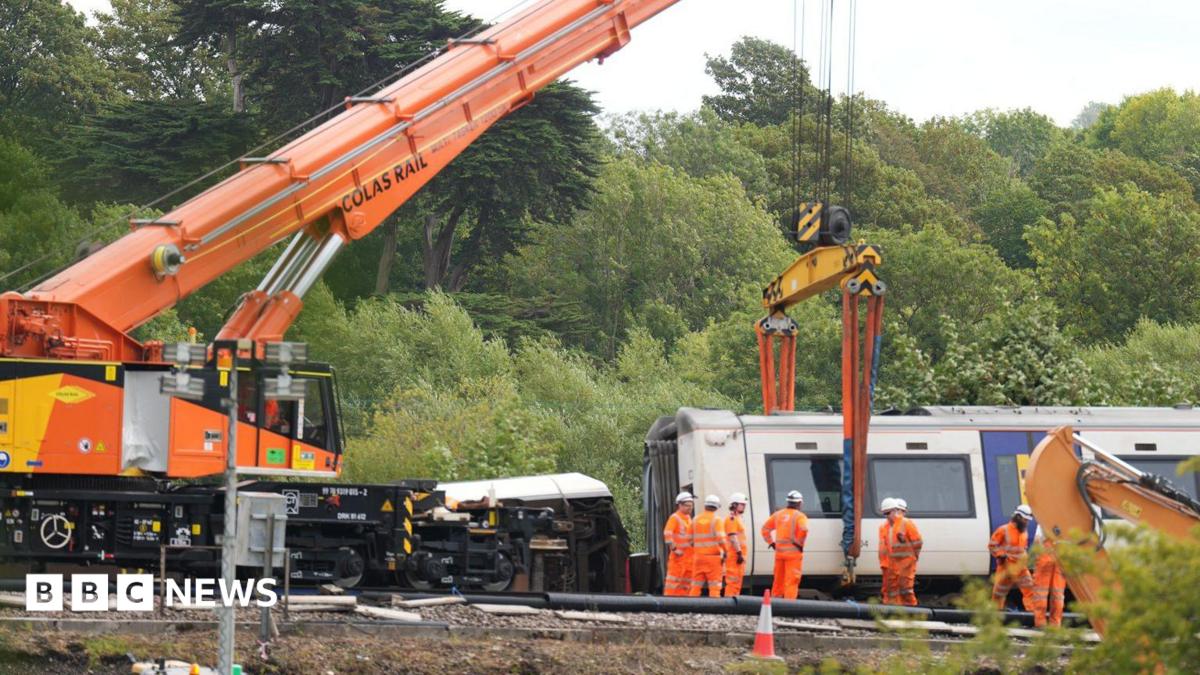
Work has begun on removing the carriages of the train that derailed near Lewes with 150 people on board.
Thirty people were injured, two seriously, when the Southern 14:24 BST service from London Victoria to Eastbourne came off the tracks last Thursday.
Video posted on social media, external showed carriages that did not derail being transported through Lewes station overnight, as recovery work continues at the site.
A preliminary report by the Rail Accident Investigation Branch (RAIB) found a defect in the track where the train derailed. Network Rail and Greater Thameslink Railway (GTR), which runs Southern, have said they will consider recommendations from the investigation and work to implement them.
Investigators are still examining how the track was inspected and maintained, the condition of the embankment and whether hot weather may have played a role, external.
Passengers who regularly use the route said the line was known for being unstable before the accident.
Rob Bradley, from Eastbourne, who was travelling on the train with his daughter, said the line was "jostly" and "does have some movement".
He said: "I never thought at all that you could end up in a derailment because of it.
"You think it's a railway and there's going to be some bumps along the way. I never thought about it leading to such an accident."
Lewes MP James MacCleary said the findings were "deeply concerning", adding: "It's kind of well-known locally how bumpy that stretch of track is."
He said it was not unusual to see "people's coffee flying around on tables and people struggling to type on laptops", and he had raised concerns with Southern on more than one occasion.
He said the big concern was the issue had been reported previously, but "we still ended up with a derailment".
Passenger John May described how people were trapped in the carriages after the train came to rest on its side.
He said some passengers managed to escape, but many had to wait in hot conditions while firefighters used ladders to help them out.
The continuing RAIB investigation will examine the cause of the derailment, the condition of the track and embankment, weather conditions, the train and the emergency response.
Test planned as line reopens
The line between Haywards Heath and Lewes is expected to reopen on 1 September.
Network Rail and Greater Thameslink Railway (GTR) said a complex programme of work had taken place to move the train and assess damage to the track and embankment so repairs could begin.
Temporary foundations and platforms for heavy machinery were built and specialist cranes brought in.
Rigorous tests and inspections are planned before the line reopens.
Lucy McAuliffe, Network Rail's Sussex route director, said the location of the derailment near the River Ouse meant reinstatement of the site was "particularly complex".
She said: "The recovery is being carried out with careful consideration for the area around the derailment site, ensuring the area's ecology is protected and being mindful of residents living nearby."
John Whitehurst, GTR chief executive, said: "Getting the line open in time for the end of the school holidays is an absolute priority for us, and we are working closely with Network Rail to achieve this despite very challenging circumstances."
After the preliminary report, McAuliffe and Whitehurst said in a joint statement Britain's railway was "one of the safest in the world".
They said it was essential to understand what happened and identify lessons that could be learned.
Follow BBC Sussex on Facebook, external, X, external, and Instagram, external and listen to BBC Radio Sussex on Sounds. Send your story ideas to southeasttoday@bbc.co.uk, external or WhatsApp us on 08081 002250.
Reporting originally appeared via BBC News. Read the full source for additional context.