Gov't Chemist Laboratory Attains Key International Accreditation
This story has significance for readers across Kenya and beyond.
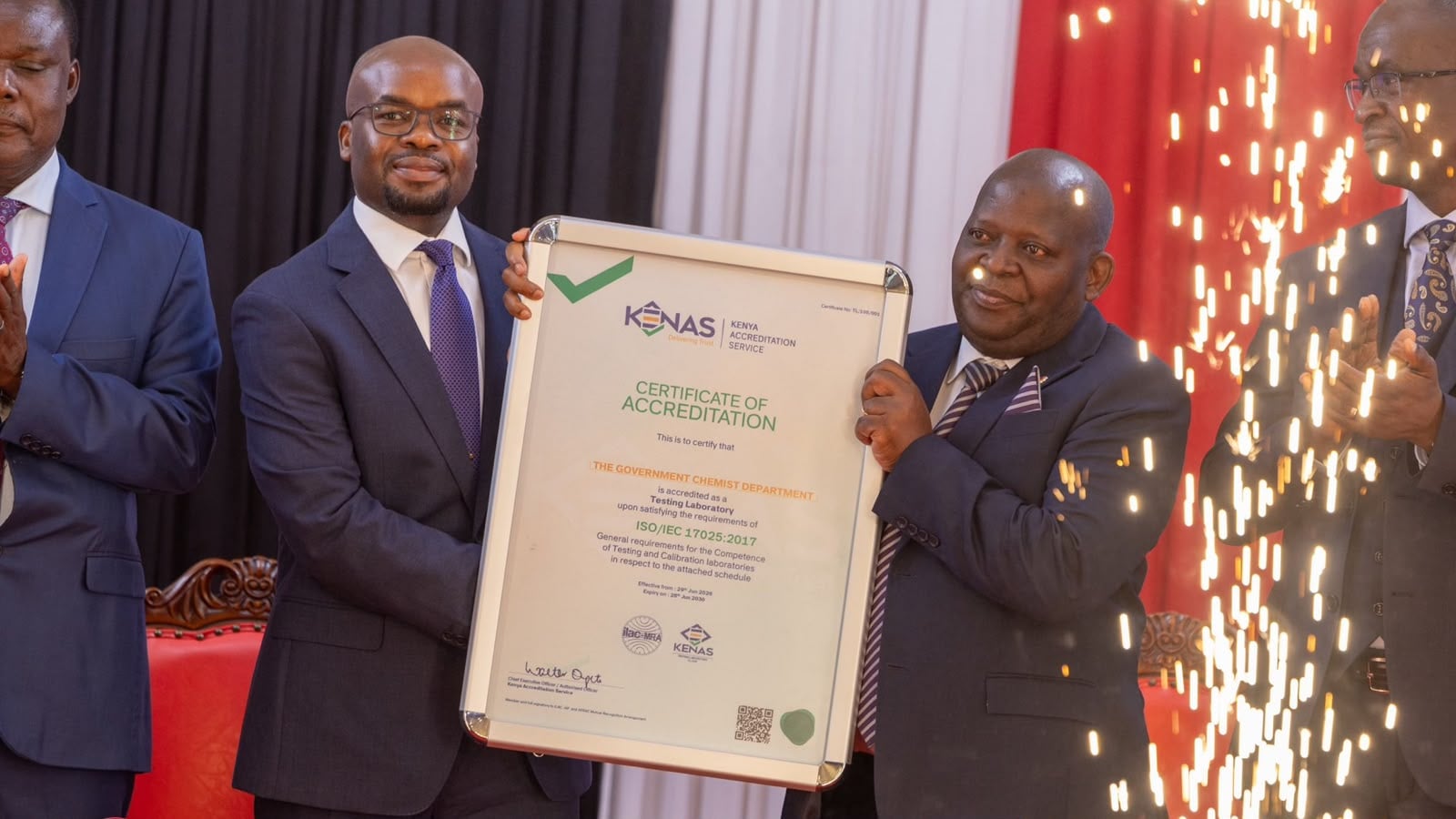
The Government Chemist Department has attained a major milestone after receiving the ISO/IEC 17025 Testing Laboratory Accreditation Certificate.
The certificate was presented to the department on Thursday, August 20, by the Kenya Accreditation Service in a ceremony presided over by Interior Principal Secretary Raymond Omollo.
Omollo said the accreditation would boost confidence in the work carried out by the department while aligning its forensic and analytical services with internationally recognised standards.
"The accreditation marks a major milestone in strengthening the credibility, quality and international recognition of our forensic and analytical laboratory services," he wrote.
Omollo congratulated the Government Chemist team for achieving the accreditation, while calling for closer collaboration among government agencies to maximise the department’s scientific capabilities for national use.
Read More
"We congratulate the Government Chemist team and call for stronger inter-agency collaboration to leverage the Department as a shared national scientific capability," the statement added.
ISO certification refers to an independent confirmation that an organisation, product, service, process or management system meets the requirements of a specific international standard developed by the International Organization for Standardization (ISO).
In Kenya, organisations can be certified against various ISO standards, including ISO 9001 for quality management, ISO 14001 for environmental management, ISO 22000 for food safety and ISO/IEC 27001 for information security.
However, ISO/IEC 17025 is different because it specifically applies to testing and calibration laboratories.
It sets requirements for demonstrating that a laboratory is technically competent and operates an effective quality system.
The accreditation means that a laboratory has been independently assessed and recognised as competent to carry out specified testing or calibration activities in accordance with internationally accepted requirements.
The accreditation is also significant for forensic work because laboratory findings may be used by government agencies, investigators and courts.
This comes weeks after Kenya was elected to the Council of the International Seabed Authority (ISA) for the 2027-2030 term during the 31st Session of the ISA Assembly held in Kingston, Jamaica.
The appointment places Kenya among the countries responsible for contributing to the work of the ISA Council, which oversees the regulation and management of mineral-related activities in the international seabed area under the framework of the United Nations Convention on the Law of the Sea (UNCLOS).
In a statement on Saturday, August 1, Foreign Affairs Principal Secretary Korir Sing'Oei said the election demonstrates the trust the international community has placed in Kenya's commitment to global ocean governance and sustainable management of marine resources.
"This election reflects the confidence of the international community in Kenya's longstanding commitment to the UN Convention on the Law of the Sea (UNCLOS); rules-based ocean governance; sustainable management of the common heritage of humankind; and advancing maritime scientific research, and an equitable and inclusive stewardship of the world's oceans," the statement read.
Sing'Oei affirmed that Kenya will continue working with member states of the International Seabed Authority to implement commitments made during key global blue economy conferences hosted by the country.
"Kenya will remain committed ensuring that the outcomes of the Nairobi Sustainable Blue Economy Conference and, the Mombasa Eleventh Our Ocean Conference - the first ever Our Ocean Conference held in the African region - are implemented in close partnership with ISA members, and in line with UNCLOS mandate," the statement added.
Reporting originally appeared via Nairobi Leo. Read the full source for additional context.